Macarthur History Guide
Campbelltown History Guide: Fisher's Ghost, Queen Street And Bradbury
Campbelltown was laid out by Governor Macquarie in 1820 on Dharawal Country, and it still keeps a surprising amount of that story on and around one main street. A convict's murder in 1826 became the country's best-known ghost story, a row of 1840s buildings was rescued from ruin in the 1960s, and the suburb of Bradbury takes its name from a hard-drinking innkeeper whose estate once ran along the southern edge of town. This guide walks you through it all, with the free places you can actually visit this spring.
Key Takeaway
Campbelltown's history is easy to explore in a weekend because the key sites are close together and mostly free. St Peter's Church (1821 to 1823), the Queen Street heritage precinct, the 1881 Old Post Office and Glenalvon House are all near the town centre, and the Fisher's Ghost story ties them together. This spring also brings the 2026 Fisher's Ghost Art Award at Campbelltown Arts Centre and the festival parade on Saturday 31 October.
Before You Set Out
A little planning turns a wander down the main street into a proper history day.
Three Stories To Follow
Campbelltown's past is easier to enjoy when you follow a thread rather than a list of buildings.
Why Campbelltown's History Is Worth A Weekend
Most visitors know Campbelltown for its shopping centres, the stadium and the train line into Sydney. Fewer realise that it is one of the towns Governor Lachlan Macquarie planned himself, and that its main street still follows the line he set out more than two centuries ago.
What makes it rewarding is how compact it is. The church Macquarie sited, the 1840s shops and inns, a Victorian post office, a colonial house museum and the locations tied to the Fisher's Ghost story are all in and around Queen Street. You can see most of them in a relaxed morning on foot, with a coffee stop in the middle.
There is also a strong local thread for anyone staying in Bradbury. The suburb is named after an early landowner whose estate bordered the town, and the creek linked to the ghost legend runs through it. That makes this a history guide you can start almost from the front door.
Dharawal Country: The Story Before 1820
Campbelltown sits on Dharawal land. The Dictionary of Sydney describes the Dharawal people travelling the Georges River, hunting across the area and using rock shelters long before any colonial grant was drawn on a map.
That history did not end peacefully. By the 1810s, competition for land and water led to armed conflict between colonists and Aboriginal people. On 17 April 1816, soldiers of the 46th Regiment, acting on Governor Macquarie's orders, attacked a camp near the Cataract River at Appin. At least 16 Aboriginal people were killed, many of them old men, women and children.
The Appin massacre has been described as the first military-ordered massacre of Aboriginal people in Australia. A memorial was installed at Cataract Dam in 2007, Campbelltown City Council holds a memorial ceremony, and in 2022 the NSW Government added the massacre site to the State Heritage Register.
Macquarie's Campbell-Town: How The Town Began
Governor Macquarie founded the town in 1820 and named it Campbell-Town in honour of his wife, Elizabeth, whose maiden name was Campbell. Council's heritage listing for St Peter's Church gives the founding date as 1 December 1820. The name was later simplified to Campbelltown.
Macquarie laid out a town grid that still shapes the centre today. The Queen Street shopping strip and Campbelltown Mall both sit within that original town area, which is why so many of the heritage buildings are clustered along one road.
Getting a town started took time. Residents formally took possession of town land in 1831, more than a decade after the founding. Look above the modern shopfronts on Queen Street and several older rooflines, verandahs and sandstone walls from that coaching-town era still show.
St Peter's Anglican Church And Its Old Graveyard
St Peter's is the best place to start, because Macquarie chose its site when he founded the town. Council's heritage record says the church was built between 1821 and 1823 and was designed and built by Francis Lawless, a foreman bricklayer from the government work gangs.
The cemetery was set aside by Macquarie, originally covering about three acres, and was established in 1822. Its oldest gravesite dates from 1823, making it the oldest cemetery in the town. It holds many headstones of early pioneers of the town and district, though it is smaller today than its original size. The rectory followed much later, in 1887.
The church group is classified by the National Trust and listed on the old Register of the National Estate. It sits on Cordeaux Street, a short walk from Queen Street.
St Peter's also has a direct link to the town's famous legend. Council's Fisher's Ghost guide records that Frederick Fisher was buried in St Peter's graveyard and that no headstone was ever erected. There is no grave to find, but standing in the graveyard gives the story a very real anchor.
The Legend Of Fisher's Ghost: What Actually Happened
Strip away the festival and the Fisher's Ghost story is a real colonial murder case, set out in detail in council's own history of Frederick Fisher.
Fisher was born in London on 28 August 1792. In 1815 he was sentenced to 14 years' transportation over forged bank notes, and he arrived in New South Wales on the Atlas in September 1816. By the 1820s he had a farm and business interests around Campbelltown, including the Horse and Jockey Inn, which he built in 1825.
On the evening of 17 June 1826 Fisher disappeared. His neighbour, George Worrall, claimed he had sailed for England. People were not convinced, and Worrall was arrested on suspicion of murder on 17 September 1826. A reward notice for the recovery of Fisher's body was published in the Sydney Gazette later that month.
Then came the part that made the story famous. In October 1826 a local farmer, John Farley, reported seeing Fisher's ghost near a bridge and pointing towards a creek that led back to Worrall's farm. On 25 October 1826 two boys found bloodstains, a lock of hair and a tooth on Fisher's farm, and an Aboriginal tracker, Namut (also known as Gilbert) of Liverpool, led searchers to a shallow grave along the creek.
Worrall was tried on 2 February 1827, found guilty and executed three days later, on 5 February. Council's account notes that he reportedly confessed before his death, claiming he had mistaken Fisher for a horse, an explanation locals did not believe.
17 June 1826
Fred Fisher disappears. Worrall says he has sailed for England.
October 1826
John Farley reports the ghost at the creek. Searchers find the grave.
5 February 1827
George Worrall is executed after his trial three days earlier.
Walk In Fred's Footsteps: A Self-Guided Ghost Trail
Council publishes a free guide called Frederick Fisher: The Legend of Fisher's Ghost, with a map that lets you walk the story through the modern town centre. It is not a numbered route, more a set of landmarks, so you can join the dots in whatever order suits you.
The guide marks these places:
- The Old Post Office: the site of Fred Fisher's farm.
- Town Hall Theatre: the site of George Worrall's farmhouse, on the western side of Queen Street, south of Allman Street.
- Dredges Cottage and the Fieldhouse Store: the site of Worrall's farm.
- Campbelltown Sculpture Garden: the location of Fisher's Ghost Creek.
- The X on the map: where Fisher's body was found.
- St Peter's Anglican Church and graveyard: where Fisher was buried.
The ghost sighting itself is traditionally placed near Queen Street and Dumaresq Street, or at the corner of Queen Street and Camden Road. Nobody can point to the exact spot, which is part of the fun.
Travelling with children? Turn the trail into a detective game: give them the timeline and let them find the farm sites, the creek and the church.
The Queen Street Heritage Precinct
The most photogenic stop is a row of four buildings at 284 to 298 Queen Street, built around the late 1840s. Together they form what council calls the Queen Street Historical Precinct, and they show what a busy coaching town looked like before the railway arrived.
McGuanne House (284)
Built by a doctor, George Fullerton, then home to the McGuanne family from 1860 until 1895.
Old Railway Hotel (288)
Still called Doyle's Hotel in 1882. The slab coach house at the rear was once used as a theatre.
Bursill's Shop (292)
Grew from a small two-storey stone store. Part of a faded shop sign was uncovered during restoration.
Coaching House (298)
Turned verandah columns with cast-iron capitals, and a central gateway that once let coaches through to the stables.
The precinct nearly disappeared. Council's heritage record says McGuanne House, Bursill's shop and the Coaching House were neglected and vandalised for years until the State Planning Authority bought them. Architect Morton Herman completed their restoration in 1964, and the Railway Hotel, which had been better kept, was restored in 1971.
All four buildings were placed under a permanent conservation order in 1979 and are classified by the National Trust. Most are in private or business use, so admire them from the footpath and respect the people working inside.
More Queen Street Landmarks To Look For
Once you have your eye in, Queen Street keeps giving. These buildings are all listed on the NSW State Heritage Register, and most can be seen in a short stroll.
- Old Campbelltown Post Office, 261 Queen Street: built in 1881 to a design by the Colonial Architect James Barnet, in the Victorian Italianate style. It is now shops and offices, and the Fisher's Ghost guide marks it as the site of Fred Fisher's farm.
- Former Commercial Banking Company of Sydney, 263 Queen Street: right next door to the Old Post Office, so the two make an easy pair to compare.
- Dredges Cottage, 303 Queen Street: a former cottage now used as offices and owned by council, added to the State Heritage Register in 1999.
- Warbys Barn and Stables, 14 to 20 Queen Street: another State Heritage Register listing on the same street.
- St John's Catholic Church, Broughton Street: another State Heritage Register church just off the main street.
Glenalvon House: Step Inside A Colonial Home
If you only go inside one historic building, make it Glenalvon House at 8 Lithgow Street. Council records it was built by Michael Byrne by 1841, on land allocated to him in 1827, with the architect unknown. Later owners included John Keighran, who owned a local flour mill, and Edwin Fieldhouse. The State Planning Authority acquired it in 1963.
Today the house is owned by council and cared for by the Campbelltown and Airds Historical Society, which was formed in 1947. Event listings describe twelve rooms open to visitors, including the drawing room, library, nursery and a children's bedroom, plus a period garden, a sandstone coach house and heritage stables.
Out the back, the Alex Goodsell Agricultural Exhibition Centre holds machinery and tools of rural life, and the collection includes everyday objects such as a gramophone, early dental X-ray equipment and a horse trough that once stood in Queen Street.
Museums and Galleries of NSW lists Glenalvon as open on the first and third Sunday of each month from 10am to 1pm, with free entry and donations appreciated. NSW event listings show upcoming open days on Sunday 18 October, Sunday 1 November, Sunday 15 November and Sunday 6 December 2026, and mention Devonshire tea from the Campbelltown Country Women's Association on some open days.
Quondong Cottage And Where To Get Visitor Information
Older guides send visitors to the Visitor Information Centre at Quondong Cottage, 15 Old Menangle Road. That has changed. Council's relocation notice says the Quondong site closed from Friday 22 August 2025 and that visitor services moved to the Campbelltown Civic Centre on weekdays, with a weekend information point at Campbelltown Arts Centre.
Quondong itself is still worth a look from the street. NSW tourism information says it was built in 1840 as St Patrick's, described as the first Catholic school in Australia built from private subscription. It stopped being a school in 1914, became a family home, and took the name Quondong after a kurrajong tree out the front that was mistakenly thought to be a native quandong.
The cottage is now owned by the Campbelltown Catholic Club, so treat it as a building to view rather than a place to go inside.
Bradbury's Own Story: From Innkeeper's Estate To Garden Suburb
Bradbury has a history of its own, and it is closely tied to the town centre. The Dictionary of Sydney explains that in the 1820s William Bradbury owned a large estate on the southern border of the new township, built a two-storey house there known as Bradbury Park, and owned the Royal Oak Inn. He drank heavily, according to the same entry, and died in 1836.
His estate was subdivided and the first allotments sold in 1844. The northern part became the edge of town, with small lots along Allman Street and the high road, now Queen Street. Tanneries worked along the creek, and in 1845 Laurence Kendall built the district's first steam flour mill.
The land south and west stayed rural for more than a century, mostly as dairy farms. Quirk Reserve, now a local park with playground and paths, occupies part of Jeremiah Quirk's old farm. The Bradbury Park mansion was demolished in 1956.
Then Bradbury became a model suburb. In 1965 Lend Lease completed the first stage of Sherwood Hills, an estate designed by planner George Clarke with sewered lots, no overhead power lines and building covenants. The same year the reserve known as Fisher's Ghost Creek Reserve was renamed Bradbury Park, an Olympic pool opened there in 1967, and the suburb was officially named Bradbury in 1969. Today it is often called Campbelltown's garden suburb.
From Railway Town To Satellite City
Campbelltown changed quickly once the railway arrived. The southern line reached the town and the station opened on 4 May 1858, connecting local farms and businesses to Sydney far more easily than the coach road.
Local government followed. Campbelltown Council was established in 1882, and in 1888 Campbelltown became the first country town in New South Wales with piped water. For decades after that it remained a quiet rural town with a small, scattered population.
The big shift came after the Second World War. In the early 1960s the state's planning authority designated Campbelltown as a satellite city and regional centre for south-west Sydney. Improved roads, rail and sewerage brought young families, and electric train services began on 5 May 1968.
Interestingly, the same planning push that turned paddocks into suburbs also saved the old buildings. The State Planning Authority bought and restored the Queen Street precinct and Glenalvon in the 1960s, which is a big reason so much early fabric survives in a city that grew so fast.
This Spring: The Fisher's Ghost Art Award And Festival Parade
The legend is still very much alive. Campbelltown Arts Centre lists the 2026 Fisher's Ghost Art Award from 26 September to 4 December 2026, with an announcement party on 30 October. The Arts Centre is at 1 Art Gallery Road, open daily from 10am to 4pm with free general admission.
The Arts Centre grounds also include the Japanese Garden and Teahouse, a gift from Campbelltown's sister city of Koshigaya in Japan. Combining the art award with a quiet walk through the garden makes an easy, low-cost afternoon after a morning on Queen Street.
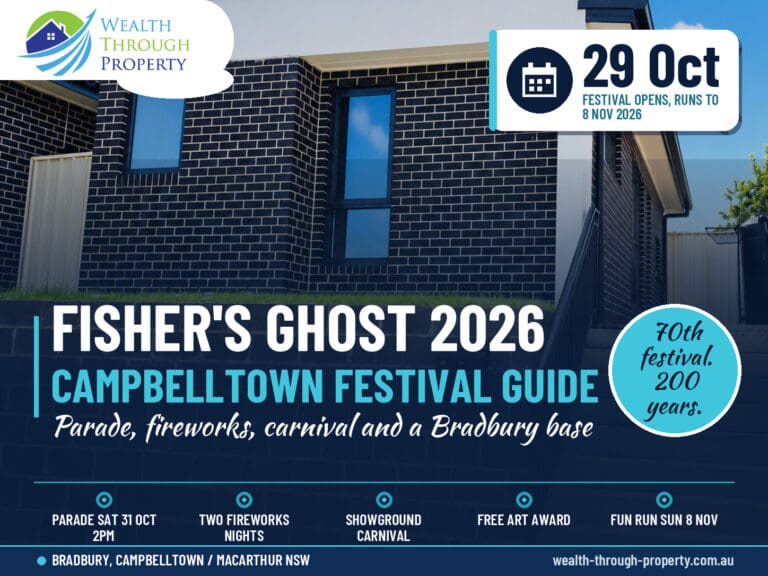
Council describes the Festival of Fisher's Ghost as its signature community festival, held each year in late October or early November. Its call for parade entries lists the 2026 parade for Saturday 31 October, from 2pm to 4pm, in the city centre. The festival dates back to a 1956 public meeting called by Mayor Jack Farnsworth, and the first festival named after the ghost was held in 1960.
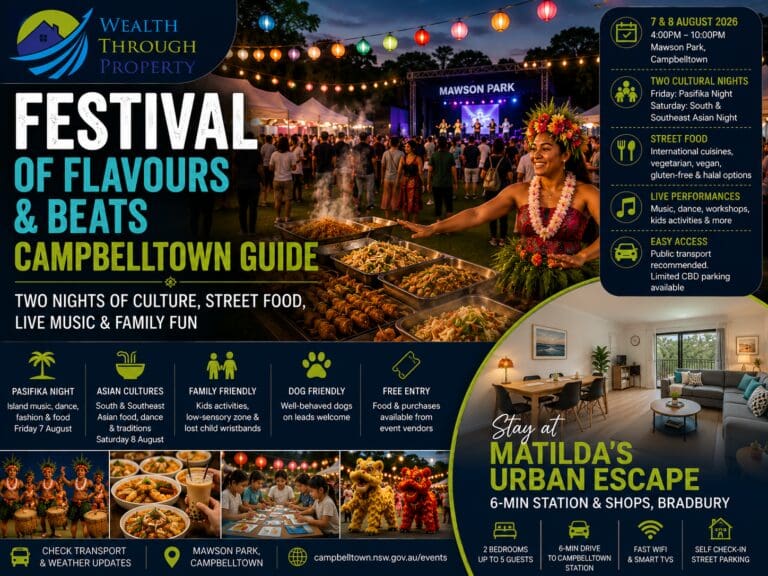
Council's event pages also describe Fisher's Twilight Streets in Mawson Park as a two-day street festival with live music, food, market stalls, a lighting display and a drone show. Confirm the 2026 dates, road closures and parking on council's What's On pages before you lock in plans.
Why Matilda's Urban Escape Suits A Campbelltown History Weekend
Matilda's Urban Escape is a 2024-built, two-bedroom private home in Bradbury, which puts you in the suburb that grew out of William Bradbury's estate and a short drive from Queen Street. The listing gives about a six-minute drive to Campbelltown Station and about four minutes to Campbelltown Mall, so a morning on the heritage trail does not need an early start or a long drive.
Bradbury Shopping Centre is about a four-minute walk away, which helps for breakfast supplies, snacks for the walk and an easy dinner after a long day on your feet. Street parking is available at the property, and bus routes 884, 885 and 885A service Bradbury through Campbelltown.
Inside, there is a combined living, dining and kitchen area with a 65-inch smart TV, a large heating and cooling unit, and a kitchen with induction cooktop, oven, microwave, dishwasher and coffee machine. That suits a history weekend well: brew a coffee before setting out, then come back to cook and look over the photos from the day.
The home has a story of its own, too. The owners rebuilt it in 2024 and named it after one of their mums, as a small family tribute and a nod to their own story of coming to Australia. It is a fitting base for a weekend spent reading about the people who shaped Campbelltown.
Where Matilda's Urban Escape fits a Campbelltown history weekend
Matilda's Urban Escape is a 2024-built two-bedroom home in Bradbury, the suburb named after William Bradbury's old estate, about a six-minute drive from Campbelltown Station and four minutes from Campbelltown Mall. That puts Queen Street, St Peter's and Glenalvon House within easy reach for an unhurried morning on the heritage trail.
Come back to a full kitchen with a coffee machine, a 65-inch smart TV and heating and cooling, with a king bedroom and a tri-bunk room that sleep up to five. Bradbury Shopping Centre is a four-minute walk for supplies, and self check-in from 3pm keeps arrival easy.
Matildas Urbanescape
Who This Bradbury Stay Suits
Couples on a history or art weekend have plenty of room. Bedroom one has a king bed, the second bedroom has a tri-bunk with a double below and a single above, and both bedrooms have their own 50-inch smart TV and mirrored built-in wardrobes.
Small families work well too. The home sleeps up to five, which suits two adults with up to three children, and the tri-bunk makes the kids' room feel like an adventure after a day chasing ghost stories around town.
History lovers who also need to keep up with work will appreciate the Wi-Fi, measured at 734 Mbps on the listing, and the dining area that doubles as a small workspace. Self check-in by lockbox from 3pm keeps arrival simple after a drive.
A Two-Day Campbelltown History Itinerary
Day One: Arrive And Explore Bradbury
Check in from 3pm, pick up supplies at Bradbury Shopping Centre and take a late-afternoon stroll to a local park. Quirk Reserve, once Jeremiah Quirk's farm, has playground and walking paths and is a nice introduction to Bradbury's farming past.
Day Two: Queen Street, Glenalvon And The Arts Centre
Drive into the town centre early. Start at St Peter's, walk Queen Street past the heritage precinct, the Old Post Office and Dredges Cottage, and stop for coffee along the way.
On an open Sunday, visit Glenalvon House before 1pm. After lunch, head to Campbelltown Arts Centre for the Fisher's Ghost Art Award and the Japanese Garden, then return to Bradbury for a relaxed dinner at home.
If You Have A Third Day
Use it for something different. The listing points to Dharawal National Park and the Australian Botanic Garden Mount Annan within driving distance, which pair well with a history weekend for anyone who wants bush or garden time after a day of buildings.
What To Pack For A History Weekend
Comfortable walking shoes come first: you will be on your feet for a few hours, and graveyard ground is rarely even. Save the Fisher's Ghost trail PDF to your phone, and if the kids are playing detective, bring a small notebook.
Spring sun in Macarthur can be strong, so pack hats, sunscreen and refillable water bottles. A light rain jacket is handy for passing showers.
Linen, towels, toiletries and general kitchen essentials are supplied at Matilda's Urban Escape according to the listing, so you only need clothes, food preferences and anything personal.
Before Leaving Home: Your Campbelltown History Check
Ready to plan it? See dates and book direct on the Matilda's Urban Escape listing, browse every WTP stay on the WTP Holiday Homes booking page, or find more local ideas in our WTP holiday home guides.
FAQs About Campbelltown History And Bradbury Stays
When was Campbelltown founded?
Governor Lachlan Macquarie founded Campbell-Town in 1820. Council's heritage record for St Peter's Church gives the date as 1 December 1820. The town was named after his wife, Elizabeth, whose maiden name was Campbell, and the spelling was later simplified to Campbelltown.
Is the Fisher's Ghost story true?
The murder was real. Frederick Fisher disappeared on 17 June 1826, his body was found in a shallow grave in October 1826, and his neighbour George Worrall was tried, found guilty and executed in February 1827. The ghost sighting reported by farmer John Farley is the legend that grew around the case.
Where is Fisher's Ghost Creek?
Council's Fisher's Ghost guide places the creek near Queen Street and Camden Road, with the Campbelltown Sculpture Garden marked as its location on the trail map. Fishers Ghost Creek also runs through the suburb of Bradbury.
Where is Frederick Fisher buried?
Council's history records that Fisher was buried in St Peter's Anglican Church graveyard on Cordeaux Street, Campbelltown, and that no headstone was ever erected.
When is Glenalvon House open?
Museums and Galleries of NSW lists Glenalvon as open on the first and third Sunday of each month, 10am to 1pm, with free entry. NSW event listings show open days on 18 October, 1 November, 15 November and 6 December 2026. Confirm with the Campbelltown and Airds Historical Society on (02) 4625 1822 before visiting.
Is there a heritage walk in Campbelltown?
Yes. Council publishes a free self-guided Fisher's Ghost trail map covering the Old Post Office, Town Hall Theatre, Dredges Cottage, the sculpture garden, St Peter's and the Queen Street heritage precinct.
Where is the Campbelltown Visitor Information Centre now?
Council's relocation notice says the centre at Quondong Cottage closed from 22 August 2025, with visitor services moving to the Campbelltown Civic Centre on weekdays and a weekend information point at Campbelltown Arts Centre. Check council's website for current hours.
When is the 2026 Fisher's Ghost parade?
Council's call for parade entries lists the 2026 Festival of Fisher's Ghost parade for Saturday 31 October, from 2pm to 4pm, in the Campbelltown city centre. Check council's What's On pages for the full festival program and road closures.
How did Bradbury get its name?
Bradbury is named after William Bradbury, who owned a large estate and the Royal Oak Inn on the southern edge of Campbelltown in the 1820s and 1830s. The area was developed from 1965 as the Sherwood Hills estate and officially named Bradbury in 1969.
How far is Matilda's Urban Escape from Queen Street?
The listing gives about a six-minute drive to Campbelltown Station and about four minutes to Campbelltown Mall, both close to Queen Street and the heritage precinct. Bradbury Shopping Centre is about a four-minute walk from the house.
Other properties to compare
Explore other stays connected to this area, guest type or holiday guide.