Home › Guides › Holiday guides
Luna's Sanctuary guide
Jervis Bay Weather In Summer: What November To January Are Really Like
Jervis Bay weather from November to January is warm rather than hot, with average top temperatures of about 22 to 25°C at the Bureau of Meteorology's Point Perpendicular station, windier afternoons than mornings and around eight or nine rainy days a month. Real heat comes in short bursts, the UV is very high and bushfire rules apply. This guide turns the Bureau's long-term figures into a practical plan for a summer stay in Sanctuary Point.
On this page ▾
- Jervis Bay Weather In Summer: The Short Answer
- Why Sanctuary Point Can Feel Warmer Than The Headland Figures
- Jervis Bay Weather In November: Late Spring Warmth And Breezy Afternoons
- Jervis Bay Weather In December: Christmas, School Holidays And Hot Days
- Jervis Bay Weather In January: The Warmest Month And Busiest Beaches
- Hot Days Around Jervis Bay: How Often And How To Handle Them
- Jervis Bay Wind: Plan Water Time For The Morning
- Summer Rain, Storms And Swimming After Rain
- UV And Sun Protection In A Jervis Bay Summer
- Bushfire Season, Fire Danger Ratings And Total Fire Bans
- Beach And Water Safety: Patrols, Sharks, Bluebottles And Birds
- Jervis Bay Water Temperature: What We Can Tell You
- A Plan For Every Jervis Bay Forecast
- Why Luna's Sanctuary Suits A Jervis Bay Summer
- How A Group Of Eight Uses The House Through A Summer Week
- A Three-Day Summer Itinerary That Bends With The Weather
- What To Pack For Jervis Bay In Summer
- Weather Tools To Check Before And During Your Stay
- Plan Your Summer Stay In Sanctuary Point
- FAQs About Jervis Bay Weather In Summer
Key Takeaway
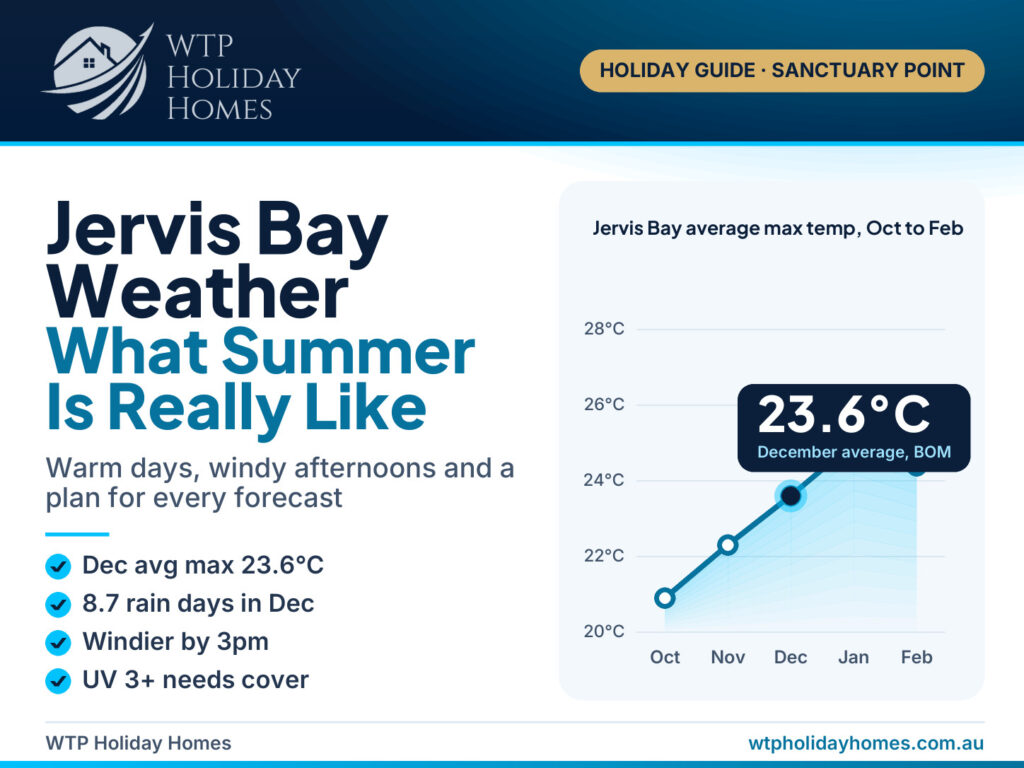
Summer at Jervis Bay is mild by Australian standards. The Bureau's headland station averages 23.6°C in December and 25.0°C in January, with only about two days a month reaching 30°C. Plan water time for mornings, watch the rain and fire warnings, and protect everyone from the sun.
In This Guide
Quick Answers
Jervis Bay Weather In Summer: The Short Answer
If you are weighing up the weather in Jervis Bay for a late spring or summer holiday, it is on your side: warm days, mild nights and only short bursts of real heat.
The figures below come from the Bureau of Meteorology's climate statistics for Jervis Bay (Point Perpendicular AWS), a weather station on the Point Perpendicular headland, with records from 2001 to 2026. They are long-term averages, not a forecast, so a given week can be warmer, cooler or wetter.
| Month | Average max | Average min | Average rain | Days with 1 mm+ rain | Days 30°C or more |
|---|---|---|---|---|---|
| November | 22.3°C | 15.5°C | 92.9 mm | 8.6 | 1.5 |
| December | 23.6°C | 17.0°C | 79.5 mm | 8.7 | 1.8 |
| January | 25.0°C | 18.6°C | 92.9 mm | 8.3 | 2.3 |
| February | 24.4°C | 18.7°C | 139.0 mm | 9.6 | 1.0 |
In plain terms: November feels like late spring, December brings the first properly warm beach days, and January is the warmest month at the headland. February stays warm but is wetter on average, which is worth knowing if you are choosing between a January and a February trip.
Source: Bureau of Meteorology, Climate statistics for Australian locations, Jervis Bay (Point Perpendicular AWS) 068151, prepared 22 October 2026, checked 28 October 2026.
Why Sanctuary Point Can Feel Warmer Than The Headland Figures
There is no long-term Bureau climate table for Sanctuary Point itself, so it helps to compare two stations. Point Perpendicular sits 85 metres up on an exposed coastal headland. Nowra RAN Air Station AWS is inland, about 28 km to the north-west, and runs hotter by day and cooler at night.
Point Perpendicular (headland)
December average max 23.6°C, min 17.0°C. Days of 30°C or more: 1.8 in December, 2.3 in January.
Nowra RAN Air Station AWS (inland)
December average max 26.3°C, min 15.0°C. Days of 30°C or more: 6.0 in December, 8.4 in January.
Sanctuary Point (in between)
The suburb sits on St Georges Basin, back from the open coast. Our reading of the two stations is that most summer days here will fall somewhere between them.
So whether you look up Sanctuary Point weather, Huskisson weather or Vincentia weather before you travel, read the forecast with this in mind. On average the headland is cooler than Nowra by day, and the Basin and the bay beaches are close enough that you can move toward the cooler air when it heats up.
For the forecast itself, use the Bureau's Jervis Bay forecast page, which sits in the Illawarra forecast area and shows the daily UV, sun protection times and fire danger rating.
Jervis Bay Weather In November: Late Spring Warmth And Breezy Afternoons
November is the shoulder month. The headland averages 22.3°C by day and 15.5°C overnight, so you will want a jumper for evenings and a wetsuit or rash vest if you feel the cold in the water. It is also the month with the strongest average afternoon wind of the year: the Bureau's lighthouse records show a mean 3pm wind speed of 22.5 km/h in November, against 15.6 km/h at 9am.
November rain averages 92.9 mm at Point Perpendicular, but the median is lower at 74.0 mm, which tells you a few heavy falls pull the average up.
Two dates fall in November this year. The Huskisson Market runs on Sunday 8 November 2026 from 8am to 1pm on the corner of Kioloa Street, according to the NSW Government events listing. Visit NSW lists the Spirits of Jervis Bay South Coast Distillers Festival on Saturday 14 November 2026 at White Sands Park, Huskisson; details are in our Huskisson food guide. November is also before the school holidays, so beaches, cafes and the national park are quieter than they will be from mid-December.
Jervis Bay Weather In December: Christmas, School Holidays And Hot Days
December brings an average maximum of 23.6°C at the headland and a mild 17.0°C overnight. It is one of the drier months there, averaging 79.5 mm, though it still averages 8.7 days with at least 1 mm of rain.
The calendar matters as much as the weather in December. NSW public school holidays (eastern division) run from Friday 18 December 2026 to Wednesday 27 January 2027, with Term 1 starting on Wednesday 3 February 2027. Christmas Day is Friday 25 December and Boxing Day falls on Saturday 26 December, so NSW adds a public holiday on Monday 28 December 2026.
What that means for your trip: the days before Friday 18 December are the last before the NSW school holidays begin. From then on, plan for busier beaches and car parks, and set off early for the popular spots. Booderee National Park says its campgrounds fill well before Christmas and summer school holiday campsites are allocated by ballot, which tells you how popular the peninsula is at this time.
The last Huskisson Market of the year is listed for 13 December 2026, 8am to 1pm. Check the organiser's details closer to the date.
Jervis Bay Weather In January: The Warmest Month And Busiest Beaches
January is the warmest month at Point Perpendicular, averaging 25.0°C by day and 18.6°C at night. It also has the most hot days at the headland, averaging 2.3 days of 30°C or more, and the highest temperature on record there for any month: 42.1°C. At Nowra the average January maximum is 27.6°C, with 8.4 days of 30°C or more.
Rain picks back up to an average of 92.9 mm, and the humidity is noticeable. At the lighthouse, 3pm relative humidity averages 71% in January.
Huskisson also has a summer carnival. The NSW Government events listing shows the last season ran from 26 December 2025 to 26 January 2026 on Tomerong Street. As of 28 October 2026, dates for the 2026–27 season had not been published, so check before you promise the kids rides.
Hot Days Around Jervis Bay: How Often And How To Handle Them
The good news is that true heat is short-lived by the coast. At the headland, days of 35°C or more average just 0.3 in November, 0.1 in December and 0.5 in January. They do happen, though, and the record highs for November (38.9°C) and January (42.1°C) show that very hot days can still arrive.
Booderee National Park's heat advice is practical. It asks walkers to walk only in the cooler parts of the day, to carry and drink at least one litre of water per person per hour, and to avoid physical activity in extreme heat if they have concerns about their health or fitness. It also lists the warning signs of heat stress, heatstroke and hyponatremia (low sodium levels in the blood).
Before 10am
Walk, cycle or explore Booderee in the cooler part of the day, as the park advises.
Middle of the day
Head indoors or into the shade. Lunch, a nap, a film or the air conditioning at the house.
Late afternoon
Back to the water once the sun drops. Paradise Beach Reserve on St Georges Basin is about a 5-minute walk from Luna's Sanctuary.
Jervis Bay Wind: Plan Water Time For The Morning
Wind shapes a Jervis Bay summer day as much as temperature does. The Bureau's long-term readings at the old Point Perpendicular lighthouse station (1957 to 2004) show average wind speeds rising through the day in every summer month:
| Month | Average wind at 9am | Average wind at 3pm |
|---|---|---|
| November | 15.6 km/h | 22.5 km/h |
| December | 14.8 km/h | 21.9 km/h |
| January | 14.2 km/h | 20.5 km/h |
Inland at the Nowra AWS (2000 to 2010 readings) the same pattern shows, with 9am averages of 12.7, 12.2 and 11.5 km/h and 3pm averages of 21.3, 22.0 and 21.4 km/h for November, December and January.
For paddlers, snorkellers and anyone taking small children into the water, the lesson is simple: go early, when the averages show the lightest wind. Our St Georges Basin guide covers kayak hire, boat ramps and the calmer corners of the lake. If you are boating on the bay, check the Bureau's Illawarra Coastal Waters Forecast (Port Hacking to Ulladulla), which warns: "Wind gusts can be 40 per cent stronger than the forecast, and stronger still in squalls and thunderstorms."
Summer Rain, Storms And Swimming After Rain
Summer rain at Jervis Bay varies a lot from year to year: December's total at Point Perpendicular ranges from 35.7 mm in a dry year (decile 1) to 129.3 mm in a wet one (decile 9). At the same station, about two or three days a month in November, December and January bring 10 mm or more, and the station's wettest day on record, 226.8 mm, fell in a November.
A detail worth knowing is what to do after the rain. Shoalhaven City Council's Beachwatch advice is to avoid swimming during heavy rain and for at least one day afterwards at ocean beaches, and for at least three days at lakes, estuaries and creeks.
Why this matters in Sanctuary Point: St Georges Basin is a coastal lake, so after a heavy downpour give it at least three days before swimming. On those days, the open bay beaches such as Collingwood Beach, about 11 minutes' drive from the house, are the better choice once a day has passed. Our Jervis Bay beaches guide compares them.
Storms can also bring strong winds and lightning. If one is forecast, keep an eye on the Bureau's warnings for New South Wales and stay off the water and exposed headlands until it passes.
UV And Sun Protection In A Jervis Bay Summer
The sun is easy to underestimate on a breezy 24°C day. Cancer Council NSW says sun protection is needed whenever the UV is 3 or above, and that in NSW the UV reaches that level for at least 10 months of the year.
On 28 October 2026 the Bureau's Jervis Bay forecast predicted a UV Index of 8, rated Very High, with sun protection recommended from 9:10am to 4:10pm. By December the solar exposure at the headland is at its yearly peak, averaging 23.5 MJ per square metre a day, the highest of any month in the Bureau's table.
Booderee National Park's safety advice lists the basics: a broad-brimmed hat, loose long-sleeved clothing, sunscreen and sunglasses, staying in the shade when you can, and remembering that you can still burn when the sun is behind the clouds. The free SunSmart app or the Bureau's forecast page gives the daily sun protection times.
Bushfire Season, Fire Danger Ratings And Total Fire Bans
Summer brings bushfire risk to the bushland around the bay, including the national parks. The Bureau's Jervis Bay forecast shows a daily fire danger rating for the Illawarra/Shoalhaven area, and the NSW Rural Fire Service's Hazards Near Me NSW app shows information about bush fires and floods.
On a total fire ban day, Booderee National Park follows clear rules. Its fire and heat safety page says that all walking trails close except the Murrays Beach, Cave Beach, Bristol Point, Green Patch and Cape St George Lighthouse access points and some trails in the botanic gardens. No fires are allowed for any purpose, gas barbecues can only be used in or within 5 metres of the provided fireplaces with water at hand and an adult in control, and the electric barbecues at Green Patch and the botanic gardens can still be used. NSW National Parks says Jervis Bay National Park is always open but may close at times due to poor weather or fire danger.
Barbecues at a holiday house on a total fire ban day: the RFS total fire ban factsheet says gas or electric barbecues can be used on a residential property within 20 metres of the house, only if a responsible adult is always attending, the ground within two metres is cleared of anything that could burn, and there is an immediate, continuous supply of water. Wood, charcoal and heat-bead fires are not allowed.
If you see a fire in Booderee, the park asks you to report it to Shoalhaven Fire Control on 02 4424 4424 or the visitor centre on 1800 357 823. In an emergency, call Triple Zero (000).
Beach And Water Safety: Patrols, Sharks, Bluebottles And Birds
It is easy to assume the calm bay beaches are patrolled in summer. In the 2025–26 season, Shoalhaven City Council's lifeguard list for 22 December to 26 January covered seven beaches, from Shoalhaven Heads and Crookhaven to Mollymook, and none of them were Jervis Bay beaches. Plan as if there is no lifeguard: swim with others, stay within your depth and watch children closely.
A NSW Government release on 26 September 2026 marked the start of the 2026–27 surf patrol season, which runs to 27 April 2027, with Surf Life Saving NSW urging people to swim at a patrolled beach between the red and yellow flags. The same release suggests downloading the SharkSmart app before you head into the water.
Bluebottle stings
The NSW Agency for Clinical Innovation advises washing off any remaining tentacles with sea water, then immersing the area in tolerably hot water at 45°C for up to 20 minutes.
Rock platforms
Booderee asks visitors to stay on marked tracks near rock platforms, watch the waves and never turn your back to the ocean.
Sick or dead birds
H5 bird flu has been detected in Booderee. The park asks you not to touch sick or dead birds or animals and to report them on 1800 675 888.
Jervis Bay Water Temperature: What We Can Tell You
"How warm is the water?" is one of the first questions people ask about Jervis Bay in summer, and one of the hardest to answer honestly. We could not find an official, published long-term average sea temperature for Jervis Bay from the Bureau or another government source, so we have not quoted one here.
What the numbers do tell you is that the air is warming from November and the warmest air arrives in January and February. A rash vest or thin wetsuit can make early summer swims more comfortable, especially for children who stay in for a long time. For a live figure on the day, check a current sea temperature reading before you go.
A Plan For Every Jervis Bay Forecast
Look at the forecast each evening and pick the day that fits.
Perfect beach day
Early swim at Collingwood Beach or a Booderee beach, lunch in Huskisson, then a late afternoon dip on the Basin. Our beaches guide has the details and Booderee's $20 one-day vehicle pass.
Hot day
Water early, shade at midday, then the Bay and Basin Leisure Centre in Vincentia. The council lists a 25 m indoor lap pool, a leisure pool with beach entry and an indoor waterslide. Check current hours with the council first.
Windy day
Paddle early, then walk the sheltered bush tracks or the foreshore. Our walks guide covers the White Sands walk, Booderee tracks and the Basin foreshore.
Wet day
The Jervis Bay Maritime Museum in Huskisson opens daily from 10am to 4pm (closed Christmas Day), with the visitor information centre inside. Adults pay $14, and children under 16 are free with an adult.
A film at Huskisson Pictures, on Owen Street at the corner of Sydney Street, is another classic wet-day option. The building dates from 1913, when the Dent family of shipbuilders built it as a hall, and films have screened there since the early 1950s. If you are travelling with a dog, our Jervis Bay with dogs guide covers off-leash areas, and NSW National Parks says pets are not permitted in Jervis Bay National Park.
Why Luna's Sanctuary Suits A Jervis Bay Summer
Summer weather here rewards a house that works in every condition, and that is where Luna's Sanctuary earns its place. It is a few minutes' walk to the St Georges Basin waterfront and about a 5-minute walk to Paradise Beach Reserve, so an early swim or paddle before the wind picks up does not need the car.
When the afternoon turns hot or wet, the house carries the day. The listing includes air conditioning, ceiling fans in the downstairs living area, two separate living areas with TVs, sofas, books and board games, and a converted-garage games room with a ping pong table, darts and fitness equipment. On a fine evening, the spacious outdoor deck has a BBQ and seating for 8, extending to 10, beside a fully fenced, fully usable backyard.
Practical details matter in summer too. Linen, towels and beach towels are supplied, there is a washing machine for sandy swimmers, and the full kitchen includes a dishwasher and an espresso machine. Pets are welcome with prior approval, for up to two.
Where Luna's Sanctuary fits a Jervis Bay summer
Luna's Sanctuary is a few minutes' walk from the St Georges Basin waterfront and about five minutes on foot from Paradise Beach Reserve, so an early swim or paddle before the afternoon wind needs no car.
When the day turns hot, wet or windy, the house takes over: air conditioning, two living areas with TVs and board games, a games room with ping pong and darts, and a deck with a BBQ beside a fully fenced backyard. It sleeps eight, and up to two pets are welcome with prior approval.
Luna's Sanctuary
How A Group Of Eight Uses The House Through A Summer Week
Luna's Sanctuary sleeps eight across four bedrooms, with one queen bedroom downstairs and a queen, a double and a bunk room upstairs. That split works well for a summer group: one couple or grandparents downstairs, families upstairs, and the bunk room for children.
The two living areas let a group split on a slow afternoon. One side can settle upstairs with the TV and sound system, in the living area that opens onto the front balcony, while the other plays board games downstairs. The games room is the release valve for restless kids when it is too hot, wet or windy for the beach, and the upstairs dining area seats six while the downstairs one seats eight.
Check-in is from 3pm and check-out is by 10am, with self check-in by lockbox. On a hot arrival day, that 3pm start pairs well with a late-afternoon swim at Paradise Beach Reserve once you have unpacked. The full room-by-room layout is on the Luna's Sanctuary listing.
A Three-Day Summer Itinerary That Bends With The Weather
Day 1: Arrive, settle, Basin swim
Shop at IGA Sanctuary Point, about 3 minutes' drive from the house, before check-in. Unpack, then walk down to the Basin for a late swim and cook on the deck. Check tomorrow's forecast, UV and fire danger rating before bed.
Day 2: The big beach day
Leave by 8am for a Booderee or Vincentia beach with your vehicle pass already bought: the Booderee entry station is currently closed, so buy online or at the visitor centre. Swim before the wind builds, head to Huskisson for lunch, about 15 minutes' drive from the house, and come home for the afternoon. If a total fire ban is declared, stick to the beach access points that stay open.
Day 3: Flexible day
If it is fine, paddle the Basin early. If it is hot, plan a Bay and Basin Leisure Centre session. If it rains, visit the Maritime Museum or catch a film at Huskisson Pictures, then a games-room tournament at home. After heavy rain, skip the Basin swim for at least three days and choose a bay beach once a day has passed.
What To Pack For Jervis Bay In Summer
Sun
Broad-brimmed hats, long-sleeved rash vests, sunscreen and sunglasses for everyone, plus a beach shade.
Heat
Large water bottles for walks (Booderee suggests a litre per person per hour) and electrolyte sachets.
Wind and cool changes
A light windproof layer and a jumper for evenings. November nights average 15.5°C at the headland.
Water
Swimmers, reef shoes for rocky entries, a thin wetsuit for those who feel the cold, and a first aid kit.
Linen, towels, beach towels, basic toiletries and kitchen starter supplies are already provided at the house, which frees up space in the car for the beach gear.
Weather Tools To Check Before And During Your Stay
Averages help you choose dates; day-to-day decisions need live tools. These are the official sources we used:
| What you need | Where to find it |
|---|---|
| Forecast, UV and fire danger rating | Bureau of Meteorology, Jervis Bay forecast |
| Bushfires and floods near you | Hazards Near Me NSW (RFS) |
| Booderee closures and alerts | Booderee fire and heat safety |
| Boating wind and waves | Illawarra Coastal Waters Forecast |
| Long-term averages | Bureau climate statistics, Point Perpendicular AWS |
Rules, opening hours and event dates can change at short notice, especially in fire season, so confirm on the official page on the day.
Sources checked 28 October 2026: Bureau of Meteorology climate statistics (stations 068151, 068034 and 068072), Jervis Bay forecast and Illawarra Coastal Waters Forecast; Booderee National Park; NSW National Parks; NSW Government school holiday, public holiday and event listings; NSW RFS; Cancer Council NSW; NSW Agency for Clinical Innovation; Shoalhaven City Council; NSW DPIRD; Visit NSW; Jervis Bay Maritime Museum; Shoalhaven Tourism.
Plan Your Summer Stay In Sanctuary Point
If you want a base that copes with whatever the Jervis Bay weather does, check live dates and prices for Luna's Sanctuary, or browse every home on WTP Holiday Homes. Booderee describes summer as a very popular period, so it pays to decide on your dates early.
FAQs About Jervis Bay Weather In Summer
What is the weather like in Jervis Bay in December?
December at Jervis Bay is warm and mostly mild. The Bureau of Meteorology's Point Perpendicular station averages a 23.6°C maximum and 17.0°C minimum, with 79.5 mm of rain over about 8.7 rainy days. Expect sunny beach days, breezy afternoons and the occasional storm or cool change.
How hot does Jervis Bay get in summer?
Average summer maximums sit in the low to mid 20s at the coast. The headland averages 25.0°C in January and about 2.3 days of 30°C or more. Heatwaves do happen, though: the station's January record is 42.1°C. Inland Nowra runs hotter, with 8.4 days of 30°C or more in January.
When is the best time to visit Jervis Bay for warm weather?
For warm air with fewer crowds, late November and early December work well, before NSW school holidays start on 18 December 2026. January is the warmest month on average, at 25.0°C at the headland, but it is also the busiest. February stays warm and is wetter on average.
Does it rain a lot in Jervis Bay in summer?
Rain is a regular part of summer but rarely constant. Point Perpendicular averages 8.3 to 8.7 days with at least 1 mm of rain in each month from November to January, and only around two or three days a month with 10 mm or more. Totals vary a lot between years.
Is it windy at Jervis Bay in the afternoon?
Yes, it is usually windier after lunch. Long-term readings at the Point Perpendicular lighthouse average 15.6 km/h at 9am and 22.5 km/h at 3pm in November, with a similar pattern in December and January. Plan paddling, snorkelling and swims with small children for the morning, when winds are lighter on average.
Is the water warm enough to swim at Jervis Bay in November?
Some people swim happily in November and others find the water fresh. We could not find an official long-term average sea temperature for Jervis Bay, so we do not quote one; check a live reading on the day. A rash vest or thin wetsuit makes longer swims more comfortable, especially for children.
Are Jervis Bay beaches patrolled by lifeguards in summer?
Not as a rule. Shoalhaven City Council's 2025–26 summer lifeguard list covered seven beaches from Shoalhaven Heads to Mollymook, none in Jervis Bay. Treat the bay beaches as unpatrolled: swim with others, stay within your depth and supervise children closely. Check the BeachSafe website for patrols before you travel.
Can you use a barbecue during a total fire ban?
Only under strict conditions. The RFS factsheet allows gas or electric barbecues on a residential property within 20 metres of the house, attended by a responsible adult, with two metres cleared around it and water immediately available. Wood, charcoal and heat-bead fires are banned, and no fire may be lit in the open.
Show 3 more questionsShow fewer questions
Is Booderee National Park open on total fire ban days?
Partly. Booderee says that during a total fire ban all walking trails close except the Murrays Beach, Cave Beach, Bristol Point, Green Patch and Cape St George Lighthouse access points and some botanic gardens trails. No fires are allowed. Gas barbecues are limited to provided fireplaces, and the electric barbecues can still be used.
When are the NSW summer school holidays in 2026–27?
For NSW public schools in the eastern division, Term 4 ends on Thursday 17 December 2026 and the holidays run from Friday 18 December 2026 to Wednesday 27 January 2027. Term 1 starts on Wednesday 3 February 2027. Expect Jervis Bay beaches and car parks to be busiest over this period.
What can you do on a rainy day near Sanctuary Point?
Huskisson, about 15 minutes' drive away, has the Jervis Bay Maritime Museum, open daily 10am to 4pm, and the historic Huskisson Pictures cinema. Vincentia's Bay and Basin Leisure Centre has indoor pools and a waterslide. At Luna's Sanctuary, the games room, board games and two living areas fill the gaps.
Other properties to compare
Explore other stays connected to this area, guest type or holiday guide.