Preston Beach Night Sky Guide
Preston Beach Stargazing: Dark Skies, Meteor Showers And Moonless Nights
Preston Beach sits 124 kilometres south of Perth, between the Indian Ocean and the lakes of Yalgorup National Park, and once the sun drops into the sea the sky above it gets properly dark. This guide covers the moon phases and meteor showers from late October to early December 2026, the best spots to look up within a short walk or drive, what you can expect to see in a spring sky, and how to plan a calm, safe night-sky weekend on the Yalgorup coast.
Key Takeaway
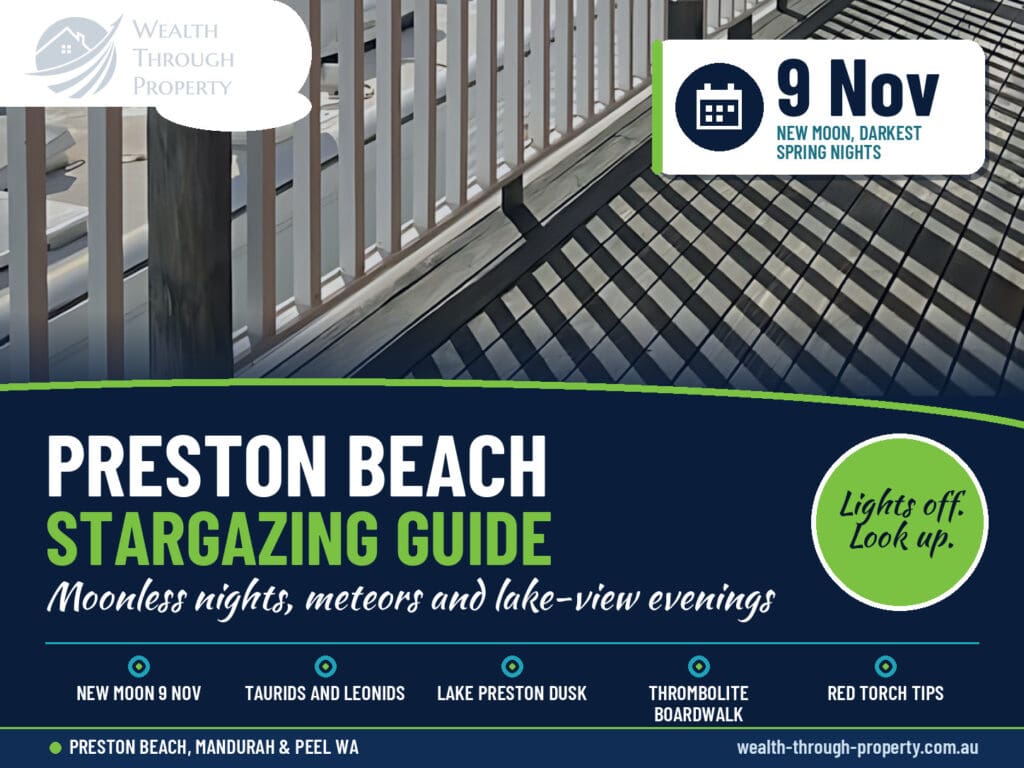
The darkest evenings in the next few weeks fall around the new moon on Monday 9 November 2026. Visit Waroona suggests aiming for nights within about three days of a new moon, which points to roughly 6 to 12 November. The Southern and Northern Taurid meteor showers peak either side of that window, and the Leonids follow in mid-November.
Before You Head Out After Dark
Night-sky trips are easy here, but a few checks make them better and safer.
Three Easy Places To Look Up
You do not need to drive far. Start close to the house and only travel when the night is worth it.
Why Preston Beach Is Such A Good Place To Look Up
Most people come to Preston Beach for the beach driving, the fishing and the quiet. Fewer realise how good the sky is. The town sits on a narrow strip of coast between the Indian Ocean and Lake Preston, with Yalgorup National Park wrapped around it. There is no big town glow on the doorstep: Visit Waroona describes Preston Beach as a coastal town 38 kilometres west of Waroona, and Perth is 124 kilometres to the north.
Visit Waroona's own stargazing page says the areas of the Shire of Waroona outside the town centre have minimal light pollution, and it names Preston Beach and Yalgorup National Park as places with coastal dunes and lakes and low light, good for naked-eye viewing. A dark horizon matters more than any telescope.
The geography helps too. The ocean lies to the west, so sunset lands on a clean sea horizon and the evening sky above the water stays free of lights. Inland, to the east, is Lake Preston and the bushland of the national park, which is where the moon and the evening constellations rise.
Spring is a comfortable time to try it: Visit Waroona notes that the autumn and spring shoulder seasons often bring clear skies and mild temperatures.
The Moon Calendar: Picking Your Darkest Nights
A bright moon washes out faint stars, the Milky Way and most meteors, so choose your dates around it. These are the 2026 moon phases for Perth time, as published by timeanddate.com:
Full moon, Monday 26 October
12:11 pm. The last week of October has bright, moonlit evenings.
Third quarter, Monday 2 November
4:28 am. From around here the moon rises late, so early evenings start to darken.
New moon, Monday 9 November
3:02 pm. The darkest nights of the period, roughly 6 to 12 November.
First quarter, Tuesday 17 November
7:47 pm. The moon is up in the evening and sets around midnight.
Full moon, Tuesday 24 November
10:53 pm. Described as a supermoon: a night for moonlight, not faint stars.
New moon, Wednesday 9 December
8:51 am. The next dark window, just ahead of the Geminid meteor shower.
Visit Waroona's advice is to choose moonless nights within about three days of a new moon. For the next couple of months that gives you two clear targets: the weekend of Friday 6 to Sunday 8 November, and the week that follows; then the weekend of Friday 11 December onwards for anyone planning further ahead.
Moon-up nights are not wasted. After full moon, the moon rises later each night, so early evenings darken again; before first quarter, a thin crescent sets early over the ocean and leaves the rest of the night dark.
Meteor Showers Between Late October And December
Meteor showers are the easiest night-sky event to enjoy as a group: you lie back, look up and wait. The American Meteor Society's 2026 calendar lists these showers in the coming weeks, with the rate shown as a ZHR, the number of meteors an observer might see per hour under ideal, very dark skies with the radiant overhead. Real counts are usually lower.
Orionids: peak night 21 to 22 October
Active 2 October to 7 November. ZHR 20. The moon is about 80 per cent lit on the peak night, so the best hours come after it sets in the early morning.
Southern Taurids: peak night 4 to 5 November
Active 20 September to 20 November. ZHR 5, with the moon only about 18 per cent lit, so expect a gentle trickle rather than a storm.
Northern Taurids: peak night 11 to 12 November
Active 20 October to 10 December. ZHR 5, with the moon about 7 per cent lit. This one falls right in the new moon window.
Leonids: peak night 16 to 17 November
Active 6 to 30 November. ZHR 15, with the moon about 45 per cent lit. Star Walk notes the near first quarter moon sets around midnight.
For the Orionids, timeanddate suggests looking north-east from the southern hemisphere, with the best viewing after midnight. The hours after midnight suit the Leonids too.
Looking further ahead, the American Meteor Society lists the Geminid peak on the night of 13 to 14 December (Have a Go News gives 14 into 15 December), with a ZHR of 150. It notes southern hemisphere observers see them only in the middle of the night and at a reduced rate.
What You Can See In A Spring Sky On The Yalgorup Coast
Visit Waroona lists the Southern Cross, the Magellanic Clouds and the Eta Carinae region as visible for most of the year from the shire. The Magellanic Clouds look like faint, detached pieces of the Milky Way and only show up well under genuinely dark skies, which makes them a good test of a clear night.
The bright core of the Milky Way is a winter favourite, and Visit Waroona gives its best season as roughly March to October in WA. That makes late October and early November the tail end of the season. Look to the west soon after the sky darkens, and you may still catch the core sinking towards the ocean horizon on a moonless night. By late November it is low in the evening twilight.
The planets add some easy wins for early risers. Have a Go News lists Venus reaching its greatest brightness in the eastern morning sky on 28 November. Star Walk describes a pre-dawn line of planets around 14 November, with Mars and Jupiter higher and Venus lower near the dawn glow, and notes that Mercury will be almost invisible from the southern hemisphere. If someone in your group is up for a sunrise walk, look east before the sky brightens.
Sunset On The Beach, Stars On The Walk Home
The easiest night-sky plan at Preston Beach starts in daylight. The beach faces west over the Indian Ocean, so the sunset sits right on the water. Take something warm to wear and stay for the first bright stars in the twilight.
Visit Waroona notes that Preston Beach is one of the few beaches in Western Australia where you can drive onto the sand, and the Shire describes 4WD access right along the beach. At dusk and after dark that means you should be aware of vehicles, keep children close and stay visible, especially on the firmer sand where cars travel. Do not settle down on the vehicle track to look up.
Stay on formed tracks through the dunes, and follow Visit Waroona's advice to check tide and wave conditions before heading to the coast at night.
The walk home is part of the fun. Once you are off the beach and away from any lights, stop for a minute and let your eyes adjust. Visit Waroona suggests allowing 20 to 30 minutes for full dark adaptation, so the sky keeps improving the longer you stay out.
Lake Preston At Dusk: Kangaroos, Waterbirds And The First Stars
Lake Preston lies on the inland side of town, in a depression between the coastal dunes, and Visit Waroona describes it as very elongated, stretching about 20 kilometres south towards Myalup. It is part of Yalgorup National Park, and the short Lake Preston Trail is the easiest way to see it.
According to Visit Waroona, the trail is a 2 kilometre return walk taking about 45 minutes, rated Class 2 and described as an easy stroll. The car park is about 10 kilometres along Preston Beach Road, just as you enter the township, with a shaded area and a viewing platform at the water's edge. The path runs through swamp paperbark on the lake shore, and part of it borders a golf course fairway where you may see kangaroos.
That makes it a lovely dusk walk. Go about an hour before sunset, watch the waterbirds from the platform, look for kangaroos coming out onto the grass, and walk back as the light goes. You will be off the trail before full dark, the safer way to use any park track.
National park rules apply here. The Parks and Wildlife Service visitor brochure for Yalgorup says no pets, no firearms, stay on marked trails, and no swimming, boating or fishing on the lakes. Leave the dog at the house for this one.
Lake Clifton Thrombolites: A Night Photography Foreground
Lake Clifton is the best-known lake in Yalgorup National Park, and the Shire of Waroona places it on Old Coast Road between Mandurah and Preston Beach. The Parks and Wildlife Service brochure describes it as having the largest known community of living thrombolites in the southern hemisphere: rock-like structures built by microorganisms that resemble some of the earliest forms of life on Earth.
The viewing site is off Mount John Road, with an observation boardwalk, picnic tables, an information bay and toilets. Visit Waroona's stargazing page names the thrombolites as a popular astrophotography foreground, and the low lake horizons are also mentioned as a good spot for aurora watching on the rare nights it happens.
The rules are simple and important. Stay on the boardwalk, because walking on the thrombolites damages them. Use a red torch, and do not shine lights on the thrombolites or on wildlife.
For photos, Visit Waroona suggests arriving at dusk to scout your composition, then using a wide-angle lens or your phone's night mode on a sturdy tripod. Use the self-timer so tapping the screen does not shake the shot, and keep the boardwalk or lake edge in the frame for a sense of place.
Set expectations for the formations themselves. The brochure says the thrombolites are most easily seen in March and April, and the park page notes they are less visible when water levels are high. In spring they may be partly under water, which can still make a beautiful reflective foreground but will not show the full structures.
Full Moon Nights: Make The Moon The Show
If your dates land on a bright moon, change the plan rather than the trip. The full moon on Tuesday 24 November falls at 10:53 pm Perth time and is described as a supermoon, when the moon is full near its closest point to Earth. The full moon on Thursday 24 December is listed by Star Walk as the largest supermoon of 2026.
Moonlit nights suit a different kind of evening. The full moon rises in the east around sunset, which at Preston Beach is the inland side, over the lake and the national park. Watching it climb above the bush, then seeing moonlight on the ocean, suits children who would not last through a late meteor watch.
Aurora Australis: Rare Here, But Worth An Alert
Visit Waroona is honest about the southern lights: aurora is rare at this latitude but possible during strong solar activity.
The Bureau of Meteorology's Space Weather Services issues three levels of notice. An Aurora Outlook gives three to seven days' warning when a large active solar region is expected to rotate into position. An Aurora Watch gives up to 48 hours' notice and is only issued in response to a significant solar outburst or a likely geo-effective coronal hole. An Aurora Alert is issued when activity favourable for viewing is actually in progress.
You can subscribe to the Bureau's aurora notices through its products and services mailing list. If an alert comes through during your stay, find a spot with a clear, dark southern view, give your eyes time to adjust, and take a few long-exposure photos even if you cannot see much with the naked eye.
Safety, Fire Season And Park Rules After Dark
Spring on the Yalgorup coast is the start of bushfire season, and that shapes how you plan an outdoor evening. The Shire of Waroona lists a restricted burning period from 1 October to 30 November, when a permit is required, and a prohibited burning period from 1 December to 31 March, when no burning is permitted. The Shire notes that dates can change. On a declared total fire ban day, you must not do anything likely to start a fire.
Inside Yalgorup National Park, the brochure says fires are allowed only in communal fire pits outside the fire ban season, and that firewood is not available at Martins Tank campground. Check current fire danger ratings and total fire bans on Emergency WA before any evening outing.
Mobile coverage can be patchy in parts of the park. The brochure recommends downloading the Emergency+ app before you visit, which can show your GPS location to give to emergency services.
Drive slowly at dusk and after dark. Kangaroos are a regular sight around Preston Beach, and they are often on or beside roads around sunset and sunrise. Preston Beach Road and Old Coast Road both pass through bushland.
Daytime Plans Between Night-Sky Sessions
Keep the days relaxed so everyone has energy for a late session.
The Shire of Waroona lists a 9-hole golf course in town, with the green fee paid on an honour system and players bringing their own clubs. Preston Beach Golf Club, at 33 Panorama Drive, welcomes golfers on Fridays and Sundays, with casual games on other days. Its fixtures page lists Club Championship Round 5 on 25 October at 9:30 am and a Halloween event on 31 October at 2 pm, with everyone welcome. Its website is under construction, so call the club on 0417 985 190 to confirm visitor arrangements.
The general store sells essentials and bait and has fuel bowsers. The Shire lists its hours as Monday to Thursday 7 am to 6 pm, Friday and Saturday 7 am to 7.30 pm, and Sunday 7 am to 6 pm. Confirm hours before relying on them for an evening supply run.
For nature in daylight, the Parks and Wildlife Service brochure describes Lake Pollard as known for high numbers of black swans from October to March, with a bird hide on its 6 kilometre trail. The lakes are a Ramsar-listed wetland visited by migratory waders such as bar-tailed godwits and red-necked stints.
Why Gracie & Dan's Coastal Retreat Suits A Stargazing Weekend
A night-sky trip needs a comfortable base close to dark places, and Gracie & Dan's Coastal Retreat fits that well. The house is a raised timber home on a quiet Preston Beach street, with a covered deck that looks across Preston Beach to Lake Preston and the bushland of Yalgorup National Park. The listing describes 180-degree views over the lake and park.
The deck is set up for long evenings outside: a long timber dining table, wicker seating, a ceiling fan and festoon lights, with an undercover outdoor kitchen beside it that has a gas BBQ and a sink. For stargazing, have dinner under the festoons, then switch them off and let the sky take over.
The listing puts the beach about a 12-minute walk away and the Preston Beach Golf Club about a 2-minute walk, so the sunset-and-stars beach walk and the Lake Preston dusk walk are both close.
When the night turns cool, there is an indoor wood fire in the living room, along with split-system air conditioning. Bedroom 1 has a queen bed facing a bay window that looks out past the deck to Preston Beach and Lake Preston, which is a pleasant way to wake up after a late meteor watch.
The house is dog friendly, with one dog welcome by approval and a fully fenced yard. As dogs are not permitted in Yalgorup National Park, one person can stay back with the dog while others head to Lake Clifton.
How Couples, Families And Small Groups Can Use The House
The house sleeps up to five across two bedrooms and two bathrooms. Bedroom 1 has a queen bed with its own ensuite, and Bedroom 2 has a tri-bunk with a queen below and a king single above. That suits a couple, a family of up to five, or two couples sharing one comfortable weekend.
For couples, the deck is the stargazing spot: sunset on the beach, dinner on the deck, then a late session with the lights off and a blanket.
For families, the shape of the night needs to change. Do the sunset beach walk and the first stars with everyone, then let the children head to bed while adults stay up for the meteors. The fenced yard and the backyard swings make the late afternoon easy too.
Parking for five cars, with room behind the gate for a boat or caravan, covers friends arriving in separate cars, and the listing notes Starlink Wi-Fi that reaches every room.
A Three-Night Dark-Sky Itinerary For 6 To 9 November
Friday: Arrive, Walk To The Beach, Learn The Sky
Check-in is from 2 pm. Walk to the beach for sunset, stay until the first stars appear, and after dinner turn off the deck lights and use a sky-map app to find the Southern Cross and the Magellanic Clouds. The moon is a thin waning crescent that rises well before dawn, so the evening sky is yours.
Saturday: Golf Or Swans By Day, Taurids By Night
Play nine holes, drive out to Lake Pollard for the black swans or enjoy the beach. Take the Lake Preston Trail an hour before sunset for kangaroos and waterbirds. After dark, settle in for a long look at the sky: the Southern Taurids peaked a few nights earlier and the Northern Taurids peak on 11 to 12 November, so the odd meteor is possible.
Sunday: Lake Clifton At Dusk
On the clearest evening of the stay, drive to the Lake Clifton thrombolite boardwalk off Mount John Road. Arrive before sunset to set up photos, stay on the boardwalk and keep lights red and low. Drive back carefully, watching for kangaroos.
Monday: New Moon And A Slow Morning
The new moon falls at 3:02 pm on Monday 9 November. Check-out is by 11 am, so have a last coffee on the deck and a beach walk. If you can stretch to an extra night, Monday and Tuesday nights sit right in the darkest part of this window.
Before Leaving Home: Your Preston Beach Night-Sky Check
Plan Your Preston Beach Night-Sky Stay
The best stargazing trips are booked around the moon. If the 6 to 12 November window suits you, check dates early, because spring weekends on this coast can book out ahead. You can see photos, house rules and live availability for Gracie & Dan's Coastal Retreat at Preston Beach, or browse every WTP stay on the Book Your Stay page.
If you are still deciding what to do on the Yalgorup coast, our other WTP Holiday Home Guides cover Preston Beach walks, swimming, food, fishing and dog-friendly days. When you are ready, book the lake-view house near the beach and golf course and leave room in the plan for a few late nights under the stars.
FAQs About Stargazing At Preston Beach
Is Preston Beach good for stargazing?
Yes. Visit Waroona says areas of the Shire of Waroona outside the town centre have minimal light pollution, and it names Preston Beach and Yalgorup National Park as low-light coastal places suited to naked-eye viewing. The town is 124 kilometres south of Perth, with the ocean to the west and national park around it.
When is the next new moon near Perth?
According to timeanddate.com, the next new moons in Perth time are 9 November 2026 at 3:02 pm and 9 December 2026 at 8:51 am. Nights within about three days of a new moon are the darkest.
What meteor showers can I see from WA in November 2026?
The American Meteor Society lists the Southern Taurids peaking on the night of 4 to 5 November, the Northern Taurids on 11 to 12 November and the Leonids on 16 to 17 November. The Orionids, which peak on 21 to 22 October, remain active until 7 November.
Can you see the Milky Way from Preston Beach in November?
Visit Waroona gives the best Milky Way core season as roughly March to October in WA. In late October and early November you may still see the core low in the west soon after dark on a moonless night, and the Magellanic Clouds and Southern Cross are visible for most of the year.
Can I take my dog stargazing in Yalgorup National Park?
No. The Parks and Wildlife Service brochure for Yalgorup lists no pets in the park. Plan park outings so someone can stay with the dog, and check Shire rules for dogs on the beach and in town.
Can you see the aurora australis from Preston Beach?
It is rare at this latitude but possible during strong solar activity, according to Visit Waroona. Subscribe to the Bureau of Meteorology's Space Weather Services aurora notices and look for a dark, clear southern horizon if an alert is issued.
Can I have a campfire while stargazing?
Be careful. The Shire of Waroona lists a restricted burning period from 1 October to 30 November and a prohibited burning period from 1 December to 31 March, and nothing likely to start a fire is allowed on a total fire ban day. In Yalgorup National Park, fires are only allowed in communal fire pits outside the fire ban season.
How many people does Gracie & Dan's Coastal Retreat sleep?
Up to five guests, across a queen bedroom with ensuite and a tri-bunk room with a queen below and a king single above, with two bathrooms. Check the live listing for availability.